The market for packaged drinking water and bottled beverages continues to expand rapidly across urban and rural sectors. For entrepreneurs entering the beverage sector, investing in a high-efficiency water bottling plant is one of the most reliable pathways to sustainable business growth.
However, transitioning from an idea to a fully operational commercial facility requires careful evaluation of production capacities, machinery synchronization, and turnkey planning.
1. What is a Complete Water Bottling Plant?
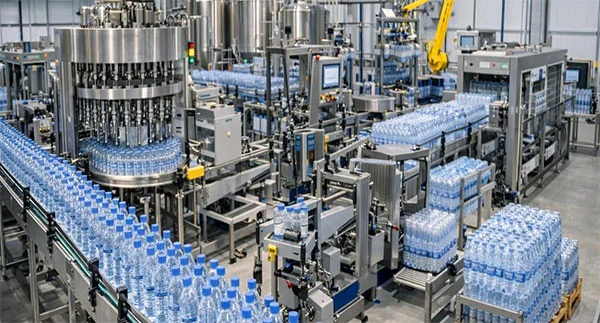
A water bottling plant is an integrated industrial production line that combines water purification, container molding, automated rinsing, precision filling, crown/screw capping, batch coding, and shrink-wrap packaging into a single continuous workflow.
Unlike small water kiosks or standalone purifiers, a commercial bottling plant is engineered for continuous, high-volume output while complying with strict food safety and hygiene regulations.
2. Key Production Capacity Tiers (BPM / BPH)
Choosing the correct scale for your factory floor depends on your target market distribution and capital investment:
- Entry-Level Plants (12 to 16 BPM): Ideal for regional startups and localized distribution, offering a balanced output with lower initial capital expenditure.
- Mid-Scale Plants (16 to 20 BPM): Designed for growing brands looking to scale up daily throughput for broader district or state-wide supply chains.
- High-Speed Industrial Plants (30 to 40 BPM & 60 BPM+): Heavy-duty automated lines equipped with Automatic Water Filling Machines designed to handle massive continuous retail and corporate demands.
3. Core Operational Units of the Plant
A professional water bottling setup coordinates three primary operational stages:
A. Water Purification & Treatment Core
Raw water is passed through heavy-duty Industrial RO Plants or Stainless Steel RO Plants, followed by ozone and UV sterilization to ensure 100% purity.
B. Bottle Manufacturing & Preparation
PET preforms are shaped into durable bottles using reliable Blow Molding Machines before being transferred via air conveyors to the filling floor.
C. Packaging & End-of-Line Automation
Finished bottles pass through labeling machines, inkjet batch coders, and thermal shrink-wrapping units to prepare multi-packs for secure warehousing and shipping.
 Users Today : 2
 Users This Month : 1639
 Total Users : 1640