Water treatment is only half of the packaged drinking water production journey.
Once water has completed the required purification and treatment stages, it still needs to reach the consumer without compromising product quality. That makes the mineral water bottling process a critical part of commercial water production.
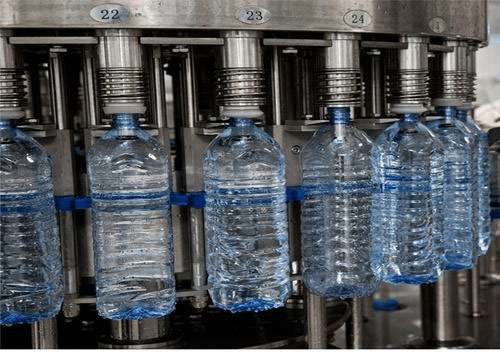
A modern bottling operation can include bottle preparation, rinsing, filling, capping, inspection, labeling, batch coding and secondary packaging. Depending on the required production volume, these operations may be performed using individual machines or integrated into an automatic water bottling line.
For businesses planning a new facility, understanding this workflow helps answer important purchasing questions:
- What bottling equipment is actually required?
- How should filling capacity be calculated?
- Should rinsing, filling and capping be integrated?
- How much automation is appropriate?
- Which bottle sizes will the line handle?
- Where can production bottlenecks occur?
This guide follows the bottle from its entry into the production area until the finished packaged product is ready for storage or dispatch.
Quick Overview of the Water Bottling Process
A typical bottling workflow can be represented as:
Treated Water Storage → Empty Bottle Handling → Bottle Rinsing → Filling → Capping → Inspection → Labeling → Batch Coding → Secondary Packaging → Finished Product
The exact configuration varies according to bottle format, production volume, automation level and packaging requirements.
Most importantly, the bottling section should be designed around the output of the water treatment section.
If you want to understand what happens before bottling, read our mineral water plant process guide, which covers raw-water treatment, filtration, RO, disinfection and treated-water storage.
Why Is the Bottling Process So Important?
Purified water can only remain suitable for packaging when downstream handling is properly controlled.
Once treated water leaves the purification section, several potential risks need to be managed:
- Contaminated bottles
- Poor bottle handling
- Inadequate rinsing
- Incorrect filling
- Improper cap sealing
- Excessive manual contact
- Unsuitable storage
- Poorly maintained filling equipment
Therefore, bottling should not be treated as simply “putting water into bottles.”
It is a coordinated packaging process.
Step 1: Treated Water Storage
Before entering the filling machine, treated water may be held in an appropriately designed hygienic storage system.
The purpose of this stage is to provide a controlled buffer between water treatment and bottling.
This can help balance situations where the purification section and filling line operate at slightly different instantaneous rates.
Important considerations include:
- Suitable contact materials
- Hygienic tank design
- Appropriate cleaning
- Protected openings
- Controlled transfer
- Suitable piping
- Prevention of unnecessary stagnation
Storage capacity should be planned alongside treatment and filling capacity rather than selected independently.
Step 2: Empty Bottle Preparation
The bottling process begins physically with the empty container.
Depending on the production setup, a facility may use ready-made bottles or another bottle-production arrangement.
Before entering the filling section, containers should be appropriately handled to minimize contamination and physical damage.
Buyers should consider:
- Bottle material
- Bottle size
- Neck dimensions
- Cap compatibility
- Bottle strength
- Conveyor compatibility
- Changeover requirements
A filling line designed around a specific bottle cannot automatically be assumed to handle every other bottle format without adjustment.
Step 3: Bottle Feeding
In a semi-automatic setup, operators may manually load bottles into the production equipment.
More automated lines may use conveyors or bottle-handling systems to supply containers continuously.
The bottle feeding rate should match the downstream equipment.
If bottles arrive too slowly, the filling machine waits.
If they arrive faster than the line can handle, accumulation may occur.
Balanced flow is the quiet engine behind efficient bottling.
Step 4: Bottle Rinsing
Before filling, bottles pass through a rinsing or washing stage appropriate to the production system and container handling process.
The objective is to prepare the internal bottle surface before product filling.
Depending on the equipment configuration, bottles may be:
- Positioned
- Inverted
- Rinsed
- Drained
- Returned to filling position
In integrated systems, rinsing can form the first section of a combined rinsing, filling and capping machine.
Step 5: Transfer From Rinsing to Filling
After rinsing, unnecessary handling should be minimized.
Integrated bottling equipment can transfer bottles directly from the rinsing section to filling.
This has several operational advantages.
It can:
- Reduce manual transfers
- Improve bottle-flow consistency
- Reduce handling time
- Support higher production rates
- Simplify line synchronization
However, the correct configuration depends on production requirements rather than automation alone.
For a detailed comparison, see our automatic vs semi-automatic water plant guide.
Step 6: Water Filling
Filling is the heart of the bottling line.
The filling system transfers treated water into each bottle at the required volume while maintaining consistent operation across the production run.
Important factors include:
- Bottle size
- Required filling volume
- Number of filling heads
- Filling technology
- Product supply
- Machine speed
- Bottle movement
- Control accuracy
A machine’s quoted speed should always be understood in the context of the bottle format on which that speed is based.
A line filling small bottles can have a very different production profile from one filling larger containers.
How Is Filling Capacity Measured?
Water filling equipment may be described in:
- Bottles per minute
- Bottles per hour
- Number of filling heads
- Litres per hour
Buyers should avoid comparing two filling machines using different capacity measurements without converting them to the same production requirement.
For example:
Bottles per hour × bottle volume = approximate packaged-water volume per hour
However, real production should also consider:
- Changeovers
- Cleaning
- Downtime
- Bottle supply
- Cap supply
- Labeling speed
- Packaging speed
The highest theoretical machine speed is not the same as guaranteed daily production.
Step 7: Bottle Capping
After filling, bottles need to be closed promptly using the selected cap system.
Depending on the equipment, caps may be:
- Supplied manually
- Fed automatically
- Oriented through a cap feeder
- Positioned over the bottle
- Tightened using the capping mechanism
Proper capping matters for both product protection and customer experience.
An incorrectly applied cap can lead to:
- Leakage
- Loose closure
- Bottle rejection
- Packaging problems
- Customer complaints
Therefore, filling speed and capping speed should be compatible.
Why Rinsing, Filling and Capping Are Often Integrated
Modern production lines frequently combine these operations into one coordinated machine.
An integrated configuration can offer:
- Shorter bottle-transfer distances
- Reduced manual handling
- More consistent production flow
- Compact equipment arrangement
- Easier synchronization
However, an integrated machine should still be selected based on actual bottle sizes and required throughput.
More integration is useful only when the surrounding production line can support it.
Step 8: Filled Bottle Inspection
After filling and capping, bottles should move through an inspection stage appropriate to the facility’s quality-control process.
- Inspection can identify issues such as:
- Incorrect fill level
- Missing cap
- Improper closure
- Damaged bottle
- Visible contamination
- Label-related issues later in the process
Depending on automation level, inspection may involve operators, sensors or specialized inspection equipment.
The purpose is simple:
Find problems before they become finished cartons or shrink packs.
Step 9: Labeling
Once bottles have been filled, capped and inspected, they can proceed to labeling.
The labeling system depends on the bottle and packaging design.
Common considerations include:
- Bottle shape
- Bottle diameter
- Label material
- Label position
- Production speed
- Branding requirements
Labels should be consistently positioned because poor label application can make an otherwise correctly produced bottle appear low quality.
Step 10: Batch and Date Coding
Traceability is an important part of packaged-product handling.
Depending on applicable requirements and packaging design, bottles may need information such as:
- Batch identification
- Manufacturing date
- Other required product information
Coding equipment should be integrated at a suitable position in the production line.
The printed information should remain clear and legible throughout normal handling.
Step 11: Secondary Packaging
Individual bottles usually need secondary packaging before transportation.
Depending on the business model, bottles may be:
- Shrink wrapped
- Packed into cartons
- Grouped into multipacks
- Arranged for other distribution formats
The packaging system should be able to handle the output from the bottling section.
This is another common source of hidden bottlenecks.
A high-speed filler followed by a slow packaging operation cannot deliver its theoretical line capacity continuously.
Step 12: Finished Product Handling
After packaging, finished products move toward storage or dispatch.
The facility should provide sufficient space for:
- Finished packs
- Product movement
- Pallet handling where applicable
- Batch segregation
- Dispatch preparation
Plant layout therefore matters far beyond the machinery footprint.
Material should move logically from raw and empty packaging materials toward finished products without unnecessary crossing or backtracking.
Bottling Process at a Glance
| Stage | Main Purpose | Key Buyer Consideration |
|---|---|---|
| Treated Water Storage | Buffer purified water | Capacity and hygiene |
| Bottle Handling | Supply containers | Bottle compatibility |
| Rinsing | Prepare bottle interior | Process and speed |
| Filling | Dispense treated water | Accuracy and throughput |
| Capping | Close bottle | Closure compatibility |
| Inspection | Identify defects | Quality-control method |
| Labeling | Apply branding | Bottle and label format |
| Coding | Product identification | Print quality and position |
| Packaging | Group bottles | Packaging speed |
| Finished Handling | Prepare for storage/dispatch | Space and workflow |
How Treatment Capacity and Filling Capacity Work Together
One of the biggest mistakes in bottling-line planning is selecting each machine separately.
Consider three production sections:
Water Treatment → Bottling → Packaging
If treatment produces less water than the filler requires, the filler eventually waits.
If filling is slower than treatment, treated-water storage requirements change.
If packaging is slower than filling, finished bottles accumulate.
The goal is therefore not to buy the fastest individual machine.
The goal is to build a balanced production line.
If your project uses reverse osmosis as part of the treatment process, our RO system for packaged drinking water guide explains feed-water analysis, pretreatment, recovery and RO capacity planning in more detail.
PET Bottle Sizes and Their Effect on Production
Bottle size has a direct impact on line planning.
A business might produce:
- 250 ml
- 500 ml
- 1 litre
- 2 litre
Other selected formats
Suppose a line handles a certain number of bottles per hour.
The total packaged-water volume changes dramatically depending on the bottle size.
For this reason, buyers requesting quotations should specify both:
Required bottles per hour + bottle sizes
rather than only saying:
“We need a high-speed filling machine.”
Semi-Automatic Bottling Workflow
A semi-automatic line may involve more manual bottle transfer between machines.
A typical workflow could include:
Manual Bottle Loading → Rinsing → Manual/Assisted Transfer → Filling → Capping → Labeling → Packing
This type of configuration can suit controlled production volumes where manual handling remains practical.
Advantages can include simpler initial equipment arrangements and flexibility for smaller operations.
However, labour dependency increases as production grows.
Automatic Bottling Workflow
An automatic system may connect several operations through conveyors and synchronized machinery.
A typical workflow could resemble:
Bottle Feeding → Automatic Rinsing → Filling → Capping → Conveyor → Labeling → Coding → Packaging
This reduces repeated manual transfers and can support more consistent throughput.
Automation becomes particularly valuable when the number of bottles handled per hour makes manual movement inefficient.
How to Identify a Bottling-Line Bottleneck
A bottleneck is the production stage that limits the output of the entire line.
Imagine the following simplified capacities:
- Rinsing: 3,000 bottles/hour
- Filling: 3,000 bottles/hour
- Capping: 3,000 bottles/hour
- Labeling: 2,000 bottles/hour
- Packaging: 1,500 bottles/hour
The production line cannot continuously deliver 3,000 finished packaged bottles per hour.
The packaging stage becomes the limiting factor.
This is why experienced buyers compare line capacity, not merely filler capacity.
Questions to Ask Before Buying Bottling Equipment
Before requesting a quotation, prepare answers to these questions:
- Which bottle sizes will we produce?
- What bottle material will be used?
- What is the bottle neck specification?
- Which closure or cap is required?
- How many bottles per hour are needed?
- What is the treated-water output?
- Will multiple bottle sizes run on the same line?
- How often will product changeovers occur?
- What labeling system is required?
- What secondary packaging will be used?
- How much factory space is available?
- Is future expansion planned?
Providing these details allows a manufacturer to recommend equipment around the actual production requirement.
Buyer Checklist for a Water Bottling Line
Before finalizing machinery, evaluate:
Required production output
- Bottle sizes
- Bottle and neck design
- Cap type
- Rinsing arrangement
- Number of filling heads
- Capping mechanism
- Conveyor configuration
- Labeling compatibility
- Coding requirements
- Packaging format
- Machine changeover requirements
- Cleaning requirements
- Utility consumption
- Spare-part availability
- Maintenance access
- Expansion possibilities
A quotation containing only machine price and production speed is rarely enough for a serious equipment comparison.
Common Bottling-Line Planning Mistakes
Choosing the Filler Before Finalizing the Bottle
Bottle dimensions and neck design affect several parts of the production line.
Finalize key packaging requirements early.
Comparing Only Bottles Per Hour
Check which bottle size and operating conditions were used to calculate the quoted output.
Ignoring Downstream Packaging
Your production line is only as fast as its practical bottleneck.
Underestimating Changeovers
Businesses producing multiple bottle formats should understand how long adjustments take and what components need changing.
Ignoring Maintenance Access
Machines need enough surrounding space for cleaning, inspection, servicing and component replacement.
Oversizing Without Market Demand
Unused production capacity still carries equipment, utility and maintenance costs.
Planning Without Future Expansion
At the opposite extreme, a facility designed with no expansion path may require significant modification when demand increases.
How to Compare Two Bottling-Line Quotations
When two suppliers submit different proposals, compare them on equal terms.
| Comparison Point | Supplier A | Supplier B |
|---|---|---|
| Bottle Size | Confirm | Confirm |
| Bottles/Hour | Compare | Compare |
| Rinsing System | Check | Check |
| Filling Heads | Check | Check |
| Capping System | Check | Check |
| Automation Level | Compare | Compare |
| Conveyor Included | Verify | Verify |
| Labeling | Verify | Verify |
| Packaging | Verify | Verify |
| Changeover Requirements | Compare | Compare |
| Utilities | Compare | Compare |
| Spare Parts | Compare | Compare |
| Installation Support | Verify | Verify |
Frequently Asked Questions
Conclusion
The mineral water bottling process connects treated water with the final packaged product, making it one of the most important stages of commercial water production.
A well-planned line coordinates bottle handling, rinsing, filling, capping, inspection, labeling, coding and packaging rather than treating each machine as an isolated purchase.
For buyers, the central question should not simply be:
“How fast is the filling machine?”
Instead, determine whether the entire production line can maintain the required output for your bottle sizes, operating schedule and packaging format.
Start with your expected daily production. Convert that requirement into bottle quantities. Then match water treatment, storage, filling and packaging capacities around the same production objective.
That approach creates a more practical foundation for discussing equipment with a manufacturer and helps prevent costly bottlenecks after installation.
Ready to build or scale your Mineral Water Manufacturing Unit?
Explore our complete Mineral Water Plant solutions engineered for high-efficiency performance. For expert guidance on layout design and custom machinery requirements, contact our engineering team today.
 Users Today : 0
 Users This Month : 1329
 Total Users : 1330