Selecting equipment for a packaged drinking water business involves more than choosing a treatment capacity. Once the required water purification process and production target have been established, another important decision appears: how much of the production line should be automated?
An automatic vs semi automatic mineral water plant comparison is especially important for businesses planning a new facility or upgrading an existing bottling operation.
A semi-automatic configuration may provide greater operational flexibility and a lower initial equipment requirement for smaller production volumes. Meanwhile, an automatic system can reduce manual bottle handling and support higher, more consistent throughput.
Neither configuration is automatically suitable for every project.
The right choice depends on production volume, bottle formats, available manpower, factory layout, expansion plans and how the different machines will work together.
This guide explains those differences from a buyer’s perspective.
Quick Answer: Automatic or Semi-Automatic?
A semi-automatic water bottling plant generally suits businesses with moderate production requirements, greater availability of manual labour and a preference for a simpler initial production setup.
An automatic water bottling plant, on the other hand, is typically considered when a business needs higher throughput, consistent bottle movement, reduced manual handling and an integrated production workflow.
Before choosing either system, buyers should evaluate:
- Required bottles per hour
- Daily operating hours
- Available manpower
- Bottle sizes and formats
- Available factory space
- Treatment-system capacity
- Packaging requirements
- Expected future demand
The objective should be to create a balanced line, not simply purchase the highest level of automation available.
What Is a Semi-Automatic Mineral Water Plant?
A semi-automatic configuration combines mechanical equipment with manual intervention at selected stages.
For example, machines may perform rinsing, filling or capping operations while workers manually load bottles, transfer containers or handle packaging.
The exact automation level varies from one production line to another.
Where Semi-Automatic Systems Can Make Sense
They may be suitable for:
- New packaged drinking water businesses
- Lower or moderate production volumes
- Regional distribution operations
- Businesses with sufficient labour availability
- Facilities with limited production space
- Companies testing market demand before expanding
However, buyers should consider the complete operating cost rather than focusing exclusively on equipment price.
More manual handling can mean higher manpower requirements as production grows.
What Is an Automatic Mineral Water Plant?
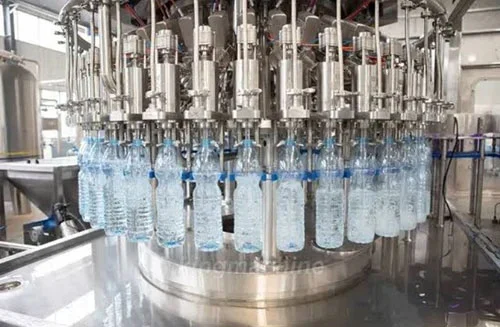
An automatic mineral water production system connects several operations through conveyors, sensors, controls and synchronized machinery.
Depending on the configuration, bottles can move continuously from rinsing through filling, capping, labeling and packaging with limited manual intervention.
The objective is not automation for its own sake.
The real benefit is production coordination.
When equipment is correctly matched, bottles move through the line at a predictable rate while reducing repeated manual handling.
Automatic vs Semi-Automatic Mineral Water Plant Comparison
| Factor | Semi-Automatic System | Automatic System |
|---|---|---|
| Production Volume | Low to moderate | Moderate to high |
| Manual Handling | Higher | Lower |
| Initial Equipment Requirement | Generally lower | Generally higher |
| Manpower Requirement | Higher | Lower per unit of output |
| Line Integration | Partial | Higher |
| Production Consistency | More operator dependent | More machine controlled |
| Space Requirement | Can be compact | Depends on complete line layout |
| Expansion | Possible with planning | Often suited to scalable production |
| Operator Skill | Manual + machine operation | Machine operation + controls |
| Best Fit | Developing production | Consistent higher-volume production |
1. Compare Production Requirements First
Production requirement should be one of the first considerations.
Suppose two businesses both plan to manufacture packaged drinking water.
One supplies a limited local market and operates a single shift. The other supplies distributors across multiple regions and expects significantly higher daily demand.
Their ideal equipment configurations are unlikely to be identical.
Instead of asking:
“Which machine is better?”
Ask:
“What production output must the entire line achieve reliably?”
This shift in thinking prevents unnecessary investment as well as under-capacity.
2. Calculate Bottles, Not Just Litres
Treatment plants are frequently discussed in litres per hour, while bottling equipment is often discussed in bottles per minute or bottles per hour.
Both measurements matter.
For example, the same volume of treated water can result in very different bottle counts depending on whether you produce:
- 250 ml bottles
- 500 ml bottles
- 1 litre bottles
- 2 litre bottles
Therefore, bottle format needs to be included when calculating production requirements.
This becomes particularly important when selecting filling, labeling and packaging equipment.
3. Evaluate Manpower Requirements
Semi-automatic systems normally depend more heavily on operators for container handling and movement between production stages.
That may be practical at lower production volumes.
However, as throughput increases, manual operations can become production bottlenecks.
Automatic systems can reduce repetitive bottle handling by using:
- Conveyors
- Automatic rinsing
- Synchronized filling
- Automatic capping
- Labeling equipment
- Packaging systems
Businesses should compare both equipment investment and recurring labour requirements over the expected operating period.
4. Examine the Filling and Capping Workflow
Filling is one of the most important points where automation affects production efficiency.
A semi-automatic system may require operators to position or transfer bottles.
An automatic filling system can receive bottles continuously through a conveyor and coordinate filling with subsequent capping.
However, the filler cannot be evaluated in isolation.
Its practical output depends on:
- Bottle supply
- Water availability
- Filling cycle
- Capping speed
- Conveyor synchronization
- Downstream labeling
- Packaging capacity
A fast filling machine connected to a slower downstream process simply moves the bottleneck elsewhere.
5. Consider Hygiene and Bottle Handling
Reducing unnecessary manual handling can support better process control in a properly designed bottling environment.
After bottles have been cleaned and water has completed its treatment process, hygienic handling remains important throughout filling and closing.
Automation can reduce the number of manual transfers between production stages.
However, machinery alone does not guarantee hygiene.
Facilities still need appropriate:
- Cleaning procedures
- Equipment sanitation
- Operator hygiene practices
- Bottle handling procedures
- Maintenance schedules
- Production-area controls
Automation and good manufacturing practices need to work together.
6. Consider Your Available Factory Space
An automatic line is not simply a collection of machines placed next to one another.
The facility needs space for:
- Water treatment
- Treated-water storage
- Empty bottle handling
- Rinsing and filling
- Capping
- Labeling
- Packaging
- Finished goods movement
- Operators and maintenance access
Conveyor routing becomes particularly important in automated installations.
Businesses planning future expansion should also avoid filling every available square metre during the first installation.
Leaving room for additional equipment or conveyor extensions can simplify later upgrades.
7. Match Water Treatment Capacity With Bottling Capacity
This is one of the most important planning principles.
Your bottling line cannot continuously produce more finished water than the treatment and storage system can supply.
Likewise, installing significantly more purification capacity than the bottling section can consume may create unnecessary imbalance.
The treatment system, storage capacity and bottling line should therefore be considered as interconnected parts of one production system.
If you need an overview of the equipment used before and during bottling, see our mineral water plant machinery guide.
8. Consider Packaging Automation Too
Automation does not end when the cap is fitted.
Depending on the product and distribution model, finished bottles may still require:
- Labeling
- Date or batch coding
- Inspection
- Shrink wrapping
- Carton packing
- Finished-product transfer
A highly automated filling section followed by heavily constrained manual packaging can reduce the benefit of upstream automation.
Therefore, evaluate the production line from empty bottle entry to finished packaged product.
9. Think About Product Changeovers
Some businesses manufacture only one bottle size.
Others need multiple SKUs.
If you expect to produce several bottle formats, ask the equipment supplier about:
- Bottle-size compatibility
- Changeover procedure
- Changeover time
- Required machine parts
- Label adjustments
- Conveyor adjustments
- Filling settings
A production line that works efficiently for one bottle format may require additional configuration for another.
Product flexibility should therefore be discussed before equipment is finalized.
10. Look Beyond Initial Investment
Equipment price is important, but it is only one part of the purchasing decision.
Buyers should consider the total operating picture.
This includes:
- Labour
- Electricity
- Water consumption
- Consumables
- Maintenance
- Spare parts
- Cleaning
- Production downtime
- Product losses
- Expansion requirements
If you are researching the financial side of a new facility, our mineral water plant setup cost guide explains the major investment categories separately.
Keeping that topic in its own article also allows this comparison to focus on the operational decision between automation levels.
When Should You Consider a Semi-Automatic System?
A semi-automatic setup may deserve consideration when:
Your initial production requirement is limited
- Demand is still developing
- Labour is readily available
- You have a constrained initial machinery budget
- Your production schedule does not require continuous high throughput
- You want to expand in stages
The critical point is ensuring that today’s lower investment does not create an expensive production bottleneck tomorrow.
When Should You Consider an Automatic System?
An automatic system may be appropriate when:
- Daily production demand is substantial
- Consistent throughput is important
- Manual bottle handling needs to be reduced
- Several machines need synchronized operation
- Labour dependency is becoming difficult to manage
- Distribution volumes are expected to increase
- The business wants a scalable production platform
Again, automation should be matched to demand.
Buying excessive capacity that remains unused does not automatically improve business performance.
What Information Should You Give a Manufacturer?
A mineral water plant manufacturer can recommend a more appropriate configuration when the buyer provides clear project requirements.
Before requesting a proposal, prepare:
- Raw-water analysis
- Required daily production
- Planned working hours
- Bottle sizes
- Expected bottles per hour
- Required packaging format
- Available factory area
- Utility details
- Current manpower availability
- Future production target
Providing this information turns the discussion from:
“Send me the price of an automatic plant.”
into:
“Design a production system around these requirements.”
The second approach produces a much more useful technical conversation.
A Simple Buyer Decision Framework
Before choosing between the two systems, answer these five questions.
1. How much finished water do we need every day?
Calculate realistic market demand rather than theoretical maximum demand.
2. How many bottles does that represent?
Convert litres into bottle quantities according to your planned SKUs.
3. How many hours will the plant operate?
Daily operating time directly affects the required hourly capacity.
4. How much manual handling is practical?
Consider both present labour availability and future production growth.
5. Where do we expect the business to be in three to five years?
Expansion planning can prevent premature replacement of major equipment.
Frequently Asked Questions
Conclusion
The automatic vs semi automatic mineral water plant decision should be based on production economics and workflow rather than automation alone.
Semi-automatic systems can be practical for businesses starting with controlled production volumes and greater manual involvement. Automatic systems become increasingly valuable when production volumes rise and consistent bottle movement, integrated filling and reduced manual handling become operational priorities.
Most importantly, evaluate the complete production chain.
Water treatment, storage, bottle handling, filling, capping, labeling and packaging need compatible capacities. A bottleneck in any one stage can restrict the output of the entire facility.
Before approaching a manufacturer, calculate your expected daily water requirement, bottle quantities, operating hours and future production targets. Those figures provide a much stronger foundation for selecting the right production configuration.
Ready to build or scale your Mineral Water Manufacturing Unit?
Explore our complete Mineral Water Plant solutions engineered for high-efficiency performance. For expert guidance on layout design and custom machinery requirements, contact our engineering team today.
 Users Today : 0
 Users This Month : 1329
 Total Users : 1330