
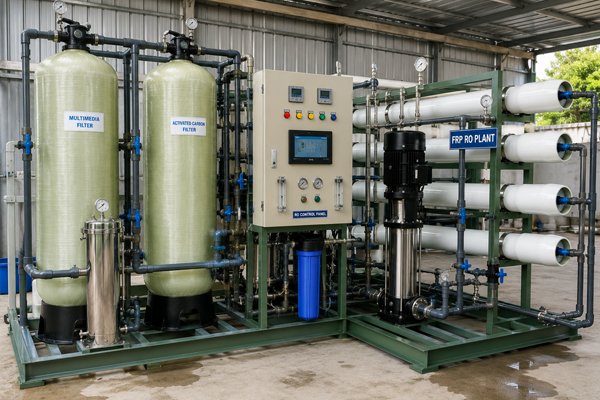
Water quality plays a crucial role in various industries, from food processing and pharmaceuticals to manufacturing and hospitality. An FRP RO Plant is one of the most effective water treatment solutions designed to remove impurities, dissolved salts, chemicals, and contaminants from water. Its durable construction and efficient purification process make it a preferred choice for businesses seeking a dependable water treatment system.
What is an FRP RO Plant?
An FRP RO Plant (Fiber Reinforced Plastic Reverse Osmosis Plant) is a water purification system that uses reverse osmosis technology to remove dissolved solids, bacteria, viruses, and other impurities from water. The plant incorporates FRP pressure vessels and components, which offer excellent corrosion resistance and long service life.
These systems are widely used for treating groundwater, borewell water, municipal water, and industrial process water.
How Does an FRP RO Plant Work?
The purification process in an FRP RO Plant typically includes the following stages:
Pre-Treatment
Water passes through multimedia filters and activated carbon filters to remove suspended particles, chlorine, and organic impurities.
High-Pressure Pumping
The water is pressurized and directed toward the RO membranes.
Reverse Osmosis Filtration
RO membranes separate dissolved salts, heavy metals, and contaminants, producing purified water.
Post-Treatment
Additional treatment such as UV sterilization or mineral dosing can be added depending on the application requirements.
Key Features of FRP RO Plants
- Strong and corrosion-resistant FRP vessels
- High water purification efficiency
- Compact and space-saving design
- Low maintenance requirements
- Energy-efficient operation
- Long service life
- Suitable for various water sources
- Available in customized capacities
Why Choose an FRP RO Plant?
Compared to conventional water treatment systems, FRP RO Plants offer superior resistance to corrosion, lightweight construction, and lower maintenance requirements. Their robust design makes them ideal for industries operating in challenging environmental conditions.
Businesses looking for a reliable and long-lasting water treatment solution often prefer FRP RO systems due to their efficiency, durability, and operational reliability.
Conclusion
An FRP RO Plant is an excellent investment for industries and commercial establishments seeking consistent access to purified water. With advanced reverse osmosis technology, durable FRP construction, and customizable capacities, these systems deliver efficient water treatment while ensuring long-term performance and cost savings.
Whether for industrial processing, drinking water applications, or commercial operations, an FRP RO Plant provides a dependable solution for achieving high-quality water purification.