
Producing packaged drinking water involves much more than simply filtering water and filling bottles. Raw water can contain suspended particles, dissolved minerals, salts, microorganisms and other impurities that must be addressed through an appropriately designed treatment process.
The mineral water plant process therefore uses multiple treatment stages rather than depending on a single filtration technology.
A typical commercial mineral water system may combine pretreatment, media filtration, activated carbon treatment, micron filtration, reverse osmosis, disinfection and hygienic storage. The exact treatment sequence, however, should be selected according to the characteristics of the incoming water and the required finished-water quality.
For a business evaluating a new water production facility, understanding these stages is useful before comparing capacities, automation levels or equipment configurations.
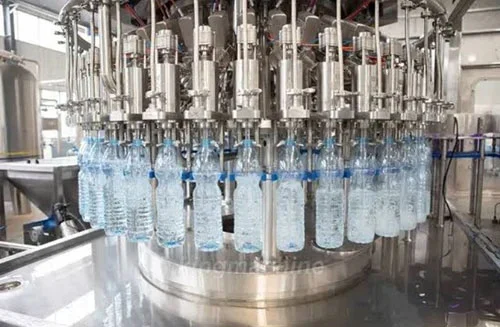
Mineral Water Plant Process at a Glance
A typical process can be summarized as:
Raw Water → Pretreatment → Sand/Media Filtration → Activated Carbon Treatment → Micron Filtration → Reverse Osmosis → Disinfection → Treated Water Storage → Bottling
Not every facility requires exactly the same configuration. Raw-water analysis is one of the most important inputs when designing a commercial treatment system.
Step 1: Raw Water Collection and Analysis
The process starts with the available source water.
Depending on the project, water may come from an approved groundwater, municipal or other suitable source. Its characteristics can vary significantly from one location to another.
Before selecting treatment equipment, representative water samples should be tested for relevant physical, chemical and microbiological parameters.
Important considerations can include:
- Total dissolved solids
- Hardness
- Turbidity
- pH
- Iron and other relevant constituents
- Microbiological condition
- Taste and odour characteristics
This analysis helps engineers determine which treatment stages are necessary.
A system designed without understanding the feed-water characteristics can be oversized, undersized or poorly suited to the actual treatment requirement.
Step 2: Pretreatment
Pretreatment prepares raw water for the more sensitive purification stages that follow.
Depending on feed-water quality, pretreatment may involve chemical dosing, clarification, oxidation, softening or other conditioning processes.
The purpose is not simply to improve the water at this stage. Good pretreatment can also protect downstream equipment and help the overall treatment system operate more reliably.
For buyers comparing systems, the important question is therefore not only:
“Does the system include RO?”
A better question is:
“What pretreatment has been designed for my raw-water quality?”
That distinction can have a major effect on long-term plant operation.
Step 3: Media or Sand Filtration
Water is commonly passed through a media filtration stage to reduce suspended matter and turbidity.
This stage helps remove larger particulate contaminants before the water reaches finer filtration and membrane systems.
Its benefits include:
- Reduction of suspended particles
- Improved water clarity
- Protection of downstream filters
- Reduced contaminant load on subsequent stages
Media filters require proper operation and periodic cleaning or backwashing according to system design and operating conditions.
Step 4: Activated Carbon Treatment
Activated carbon filtration is commonly used where reduction of chlorine, undesirable odour, colour or certain organic compounds is required.
This stage can be particularly important because some downstream treatment components are sensitive to oxidants such as free chlorine.
Activated carbon performance depends on several factors, including water quality, flow rate, media condition and maintenance.
It should therefore be treated as a functional process stage rather than simply another tank installed in the line.
Step 5: Fine or Micron Filtration
After primary filtration, finer cartridge or micron filtration can be used to capture smaller particles.
This provides another protective barrier before membrane treatment.
A typical filtration sequence progressively reduces the particle load rather than asking one component to perform the entire purification job.
This staged approach is one reason commercial water treatment systems differ from simple domestic purification units.
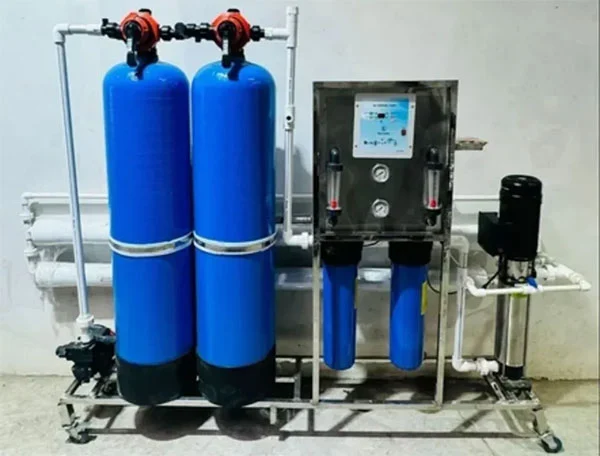
Step 6: Reverse Osmosis Treatment
Reverse osmosis is often one of the central treatment stages where the feed-water condition and desired product-water specification call for membrane separation.
In an RO system, pressure is used to move water through a semi-permeable membrane. The system separates a portion of dissolved substances from the treated water stream.
RO performance depends on factors such as:
- Feed-water quality
- Feed pressure
- Membrane selection
- Water temperature
- Pretreatment effectiveness
- Recovery settings
- Membrane condition
This means an RO system should not be selected only by its nominal litres-per-hour rating.
Two facilities requiring the same output can need different pretreatment, membrane arrangements or operating conditions because their source-water characteristics differ.
Step 7: Disinfection
Producing clear-looking water is not enough. Microbiological control is also an important part of hygienic packaged-water processing.
Depending on mineral water plant design, technologies such as ultraviolet treatment, ozone or an appropriate combination may be incorporated.
The objective is to maintain suitable microbiological control before the water reaches final storage and filling.
Good hygiene practices must continue downstream as well. Poorly maintained tanks, pipelines or filling equipment can undermine the work performed by the upstream purification system.
Step 8: Treated Water Storage
After treatment, purified water may be transferred to a hygienically designed storage tank before bottling.
Storage is an easily overlooked part of the production chain.
Important design and operational considerations include:
- Suitable contact materials
- Hygienic tank design
- Protected openings
- Appropriate cleaning procedures
- Controlled transfer to the filling section
The goal is to preserve treated-water quality between purification and packaging.
Step 9: Preparing Water for Bottling
Once treatment is complete, the water moves toward the packaging section.
Depending on the facility configuration, the downstream process may include:
- Empty container handling
- Bottle rinsing or washing
- Hygienic filling
- Capping
- Inspection
- Labeling
- Batch/date coding
- Secondary packaging
- Finished-product handling
This is where water treatment and packaging become one continuous production workflow.
Water Treatment vs Bottling: Why the Difference Matters
Businesses sometimes evaluate a project as if the water purification plant and bottling line were interchangeable.
They perform different jobs.
| Treatment Section | Bottling Section |
|---|---|
| Handles incoming water | Handles finished treated water |
| Reduces targeted contaminants | Places water into containers |
| Uses filtration and purification equipment | Uses rinsing, filling and capping equipment |
| Designed around water analysis | Designed around bottle format and output |
| Focuses on water quality | Focuses on hygienic packaging and throughput |
A complete production facility has to coordinate both sides.
Increasing filling speed without sufficient treatment output creates a bottleneck. Likewise, installing a large treatment system does not automatically increase production if the filling and packaging sections cannot handle the available water.
What Determines the Correct Treatment Process?
There is no universal treatment flow suitable for every project.
The appropriate process depends on factors including:
- Raw-water characteristics
- Required finished-water specification
- Desired hourly production
- Operating hours per day
- Available space
- Utility availability
- Local compliance requirements
- Future expansion plans
This is why buyers should avoid selecting a system based purely on the lowest equipment price or a litres-per-hour figure.
The complete process design matters.
How Much Production Capacity Do You Actually Need?
Capacity should be considered from both the treatment and packaging sides.
For example, a business expecting substantial daily bottle output should calculate:
Required finished water → operating hours → treatment capacity → storage requirement → filling-line throughput
It should also account for process losses, cleaning requirements and realistic operating efficiency.
A higher nominal capacity is not automatically the better investment. The objective is to create a balanced production line in which treatment, storage, filling and packaging work together.
Questions to Ask Before Selecting a Water Treatment System
Before requesting a quotation, buyers can prepare the following information:
- What is the raw-water source?
- Has the raw water been tested?
- What production volume is required per day?
- How many operating hours are planned?
- Which bottle sizes will be produced?
- Is future capacity expansion expected?
- What level of automation is required?
- What utilities are available at the facility?
- How will treated water be stored?
- How will the treatment system connect with the bottling line?
Providing these details allows a manufacturer to recommend a system based on the actual application rather than a generic configuration.
Common Mistakes When Planning the Process
Selecting Capacity Before Testing Water
Plant capacity alone does not determine treatment design. Source-water quality has to be considered first.
Ignoring Pretreatment
RO membranes and other downstream components depend on appropriate feed conditions. Inadequate pretreatment can create operational problems.
Treating Storage as an Afterthought
Treated water needs hygienic handling until it reaches the bottle.
Buying Treatment and Filling Equipment Separately Without Planning Flow
The two sections need compatible capacities to avoid bottlenecks.
Planning Only for Current Demand
Where growth is expected, the layout and utilities should make future expansion practical.
Why Process Design Matters to Commercial Buyers
The best water production facility is not necessarily the one with the greatest number of machines.
It is the one where each treatment stage has a clear purpose.
For commercial buyers, a properly planned process can support:
- Consistent treatment performance
- More predictable production
- Better equipment utilization
- Easier maintenance planning
- Reduced bottlenecks
- Hygienic product handling
- Future production expansion
This is why process engineering should come before equipment purchasing.
Frequently Asked Questions
Conclusion
Understanding the mineral water plant process helps buyers evaluate a water production project beyond basic equipment specifications.
A properly planned facility moves water through a sequence of purpose-designed stages, beginning with raw-water assessment and pretreatment, followed by filtration, membrane treatment where appropriate, disinfection, hygienic storage and finally bottling.
The most suitable process is therefore not simply the system with the largest capacity or the most equipment. It is a configuration designed around the source water, required output, packaging operation and long-term production objectives.
For businesses planning a new packaged drinking water facility, defining these requirements before requesting machinery quotations can make discussions with a plant manufacturer significantly more productive.
Ready to build or scale your Mineral Water Manufacturing Unit?
Explore our complete Mineral Water Plant solutions engineered for high-efficiency performance. For expert guidance on layout design and custom machinery requirements, contact our engineering team today.
 Users Today : 0
 Users This Month : 1329
 Total Users : 1330